
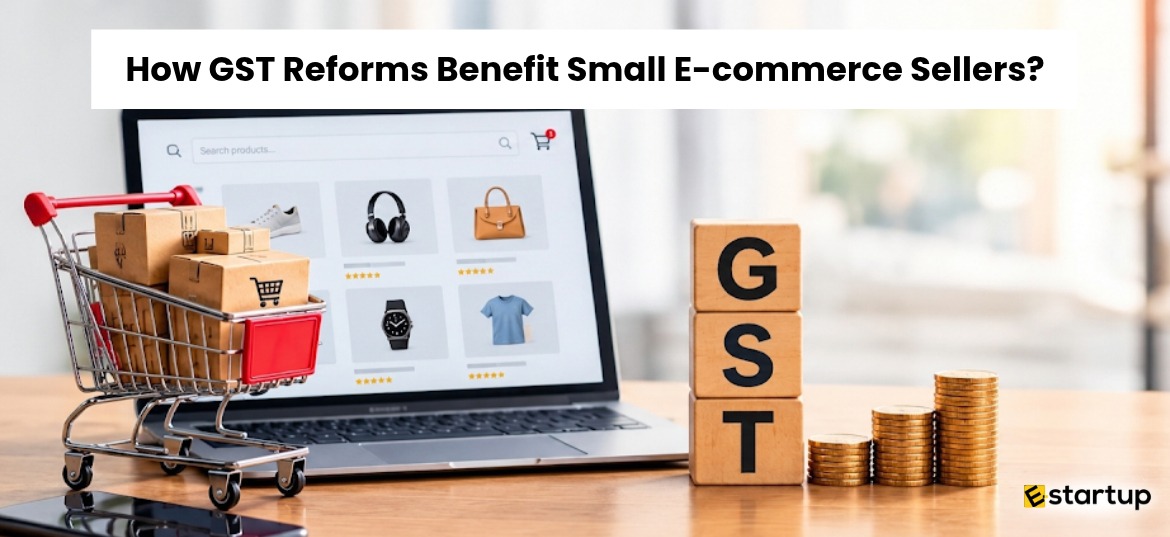
New opportunities in e-commerce have opened up for small businesses, home-based entrepreneurs, artisans, local manufacturers, and many others. However, GST compliance and interstate sales can be challenging for small sellers who want to sell their products online.
The recent GST reforms for e-commerce sellers aim to simplify registration and make it easier for eligible businesses to expand their reach through online marketplaces. These changes can reduce certain administrative difficulties and help small sellers explore new markets. Let’s look at the recent changes and understand how they can benefit small e-commerce businesses.
1. Simplified GST Registration for Small Sellers
The GST Council has recommended measures to simplify the GST Registration process for eligible e-commerce sellers. These measures aim to make registration easier for small businesses and reduce the difficulties associated with maintaining a place of business in multiple states.
The simplified registration mechanism for eligible sellers allows them to declare an e-commerce operator’s warehouse as their principal place of business in a state or union territory where they do not have a physical presence, subject to the prescribed conditions.
The potential benefits of these changes include:
- Easier access to online marketplaces.
- Reduced administrative difficulties.
- Better opportunities to reach new markets.
- Reduced dependence on maintaining separate business premises in every state, where permitted.
These GST reforms for e-commerce sellers can be particularly helpful for small manufacturers, artisans, and home-based entrepreneurs who want to expand their businesses through e-commerce platforms.

2. Easier Interstate Business Expansion
Interstate sales may involve additional registration and compliance requirements. These requirements can create challenges for small sellers who want to expand their businesses across India. The simplified registration mechanism aims to make interstate expansion easier for eligible sellers who supply goods through e-commerce operators.
Example: A handicraft seller from Jaipur wants to sell products to customers in Maharashtra through an online marketplace. Under the applicable scheme, the seller may be able to declare the marketplace’s warehouse in Maharashtra as the principal place of business without maintaining separate physical business premises there.
However, the seller must fulfil the prescribed eligibility criteria and other applicable conditions. These reforms do not automatically remove all interstate GST registration or compliance requirements.
3. Simpler Compliance and Faster Registration
Small businesses which do not have separate accounting personnel will find it hard to keep GST records. Streamlining of the registration process will aid in enabling the seller to understand what is expected of him/her and hence apply for registration successfully.
The GST registration system on an automated basis that came into effect from 1st November 2025 is characterized by provision of registration within three working days for qualifying applicants satisfying the relevant conditions.
The potential benefits include:
- Simpler registration procedures.
- Less confusion when submitting applications.
- Faster registration for eligible applicants.
- More time to focus on sales and customer service.
Proper GST Registration remains essential for businesses that are required to register. Sellers must provide accurate information and maintain the necessary business records to meet applicable GST requirements.
4. Better Compliance and Tax Planning
As per the 56th GST Council meeting, there have been recommendations of modifications in GST rates applicable on certain goods and services, where most of the GST rates have become effective from 22nd September 2025. Those traders operating small business entities must be aware of GST rates applicable to them.
| Business activity | Potential benefit |
| Product pricing | More accurate tax calculations |
| Invoicing | Fewer rate-related errors |
| Recordkeeping | Easier compliance management |
| Sales planning | Better visibility into product costs |
Reforms in GST for online businesses can be useful in developing financial planning for these companies. Yet again, how useful the reform is for a particular business depends on the product being sold, GST levied on such products, and other related factors.
5. What Should Small Sellers Do Now?
To ensure readiness for these changes, the measures that small e-commerce sellers need to undertake include:
Eligibility check: Check whether your business is eligible for simplified GST registration based on the chosen scheme.
GST Registration: Undertake the process of GST Registration if registration is mandatory or if the chosen scheme requires registration.
Keeping records: Maintain systematic records of invoices, purchases, sales, and other business transactions.
Checking tax rates: Ensure the correct GST rate applicable to every product and revise prices/invoices if necessary.
Implementation check: Check the latest GST Notifications, Guidelines, Scheme terms and conditions to determine applicability to your business.
There are several GST reforms that have been implemented recently and can be used by e-commerce sellers in their favor to make their business activities easier. Yet, there are still some GST-related responsibilities that cannot be avoided due to these reforms.
Conclusion
The introduction of GST reforms for e-commerce suppliers is one of the key steps towards simplification of the process and enabling expansion of eligible small businesses. It would be necessary for businesspeople to familiarize themselves with the relevant regulations, determine their eligibility for the program, and conduct GST Registration in cases where it is necessary.
FAQs
Q1. How Can GST Reforms for E-commerce Sellers Benefit Small Businesses?
These measures would facilitate registration for eligible sellers as well as make interstate growth of business simpler in certain conditions. This would allow small business owners to sell products to more customers via online trading platform without having physical business in each and every state.
Q2. Is GST Registration Mandatory for All Online Sellers?
This is not necessarily the case. Certain eligible sellers could be exempted from certain conditions according to GST law. It depends on many parameters like turnover, type of products or services sold, seller’s location, as well as the selling platform chosen by the seller.
Q3. Can Unregistered Sellers Sell Goods on an E-commerce Platform?
Yes, unregistered but eligible sellers can sell their goods through an e-commerce portal provided they satisfy certain criteria. These include limitations to turnover, conditions for enrollment, prohibition on supplies across states, and other such criteria.
Q4. Can Small Sellers Use an E-commerce Warehouse as Their Principal Place of Business?
Yes, an eligible seller can treat the warehouse of the e-commerce operator as his/her principal place of business in a particular state or union territory where the seller has no physical presence. The criteria prescribed in that regard include the permission from the e-commerce operator, tax liability limitations, and others.
Q5. Do These Reforms Exempt Sellers from GST Compliance Requirements?
The reforms make some registration processes easier, but they don’t eliminate all the GST compliance requirements. It is mandatory that sellers comply with the relevant invoicing, tax payment, bookkeeping, and returns filing.
Moreover, if you want any other guidance relating to UAE VAT Law 2026 , please feel free to talk to our business advisors at 8881-069-069.
Download the E-Startup Mobile App and never miss the latest updates relevant to your business.